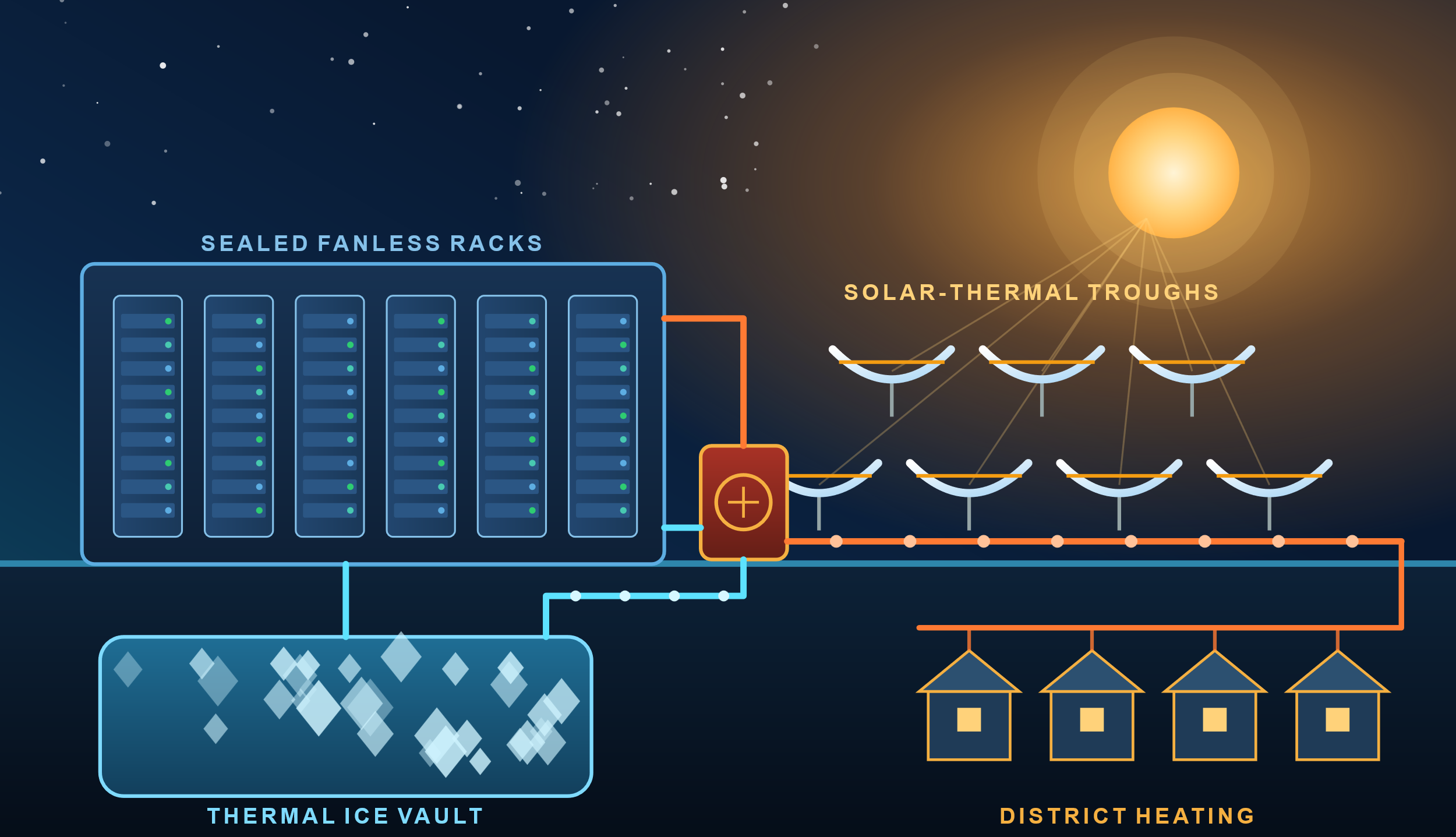
By Umar Al Farooq · Technical Report, October 2026
A comprehensive engineering framework combining sealed intelligent racks, solar-thermal cascades, heat-pump amplification and underground cryo-storage.
1. Executive Summary
Traditional data center architectures present an unsustainable compromise between massive electricity consumption, local water depletion, and severe mechanical noise pollution. To solve these foundational flaws simultaneously, this technical blueprint outlines a completely closed, circular ecosystem. By shifting from the chassis level to an integrated, unified frame layout, we eliminate internal server fans and air-forced dust vectors entirely. This design leverages a temperature-amplifying mechanical heat pump to compress low-grade server exhaust, merges it with daytime solar-thermal concentrated energy collectors, and feeds an industrial absorption chiller. Excess thermal energy is dynamically shunted to an underground Thermal Energy Storage (TES) ice vault at night, creating a zero-water, ultra-silent, hyper-efficient computing matrix ideally suited for deployment in arid, grid-stressed environments.
2. Integrated Fanless Sealed Rack Architecture
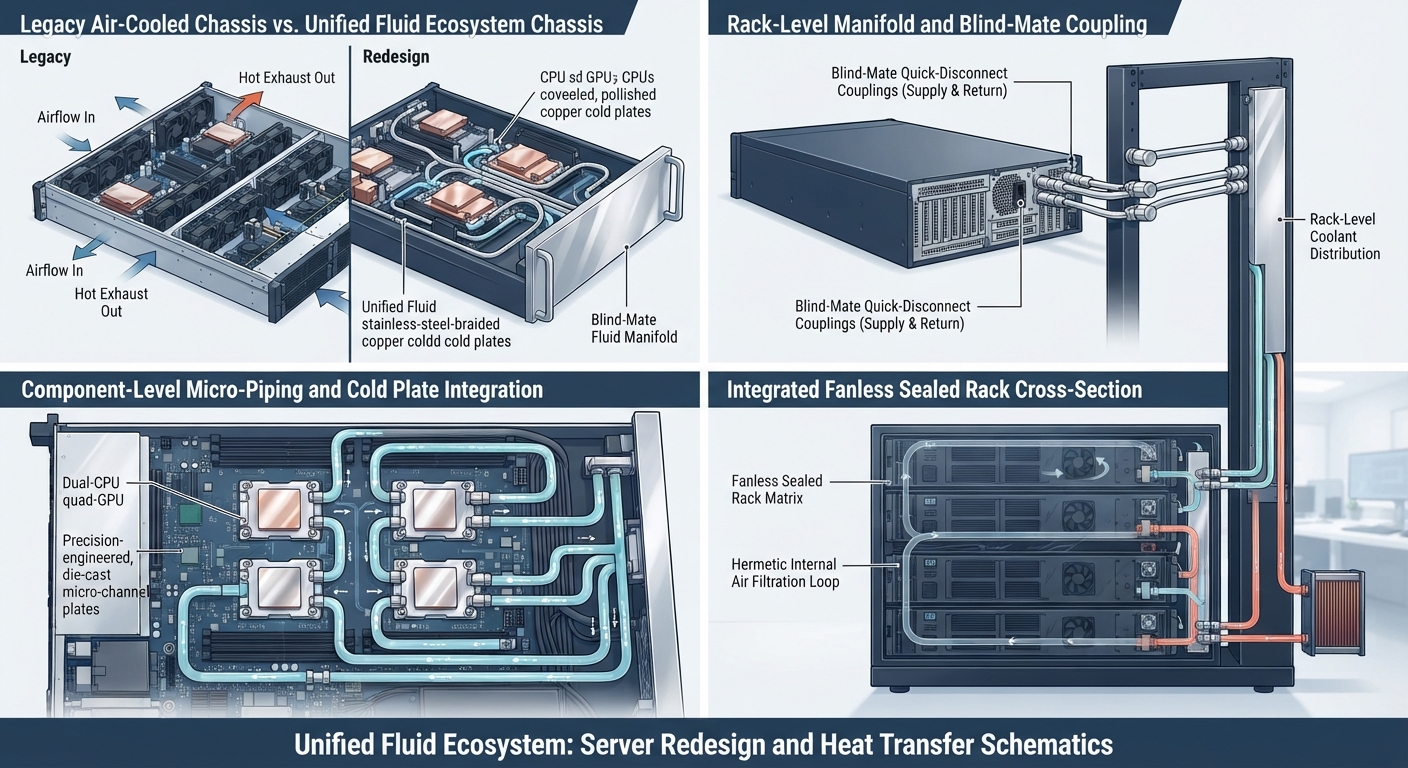
Modern motherboards, silicon chips (CPUs/GPUs), and servers are historically engineered to sit inside modular, separate chassis, relying on arrays of small, loud, high-RPM internal fans to force ambient room air across fins. This legacy architecture introduces structural points of failure, creates acoustic noise, and continuously pulls airborne dust and particulate matter onto delicate circuitry, leading to electrostatic degradation. This section summarizes the rack architecture; detailed component tolerances, materials, and coupling specifications are maintained in a companion document, the Unified Fluid Rack Technical Specification (Rev. A).
2.1 Direct-to-Rack Fluid Loops and the Fanless Chassis
This framework proposes eliminating server fans entirely by integrating the thermodynamic heat exchanger directly into the server rack framework. Each individual blade or node is engineered as a fanless, sealed metal cartridge. The silicon components are directly mated to internal micro-channel copper cold plates. When a blade is slotted into the rack, it self-seals into a pressurized rack-level manifold using blind-mate quick-disconnect liquid couplings. Instead of air moving through the node, a specialized non-conductive dielectric fluid or treated distilled water loop moves through the inner infrastructure of the rack, absorbing heat seamlessly without creating sound.
2.2 Hermetic Air Filtration and Dust Prevention
Because the servers do not rely on room ventilation, the entire multi-rack enclosure can be completely sealed from the outside environment. The chassis or rack container functions as a dust-free bunker. A centralized, positive-pressure air loop cycles within the sealed cabinet through an ultra-low-penetration air (ULPA) or high-efficiency particulate air (HEPA) filter. Since internal air velocities are fractional compared to rapid fan-forced enclosures, dust ingress is entirely eliminated, extending component life spans and reducing thermal resistance caused by dust accumulation.
3. The Combined Solar-Thermal Energy Cascade
To cool high-density infrastructure without consuming megawatts of traditional grid energy, this design blends the low-grade internal heat from the servers with high-grade external heat collected from the sun.
3.1 Squeezing the Loop: Heat Pump Compression
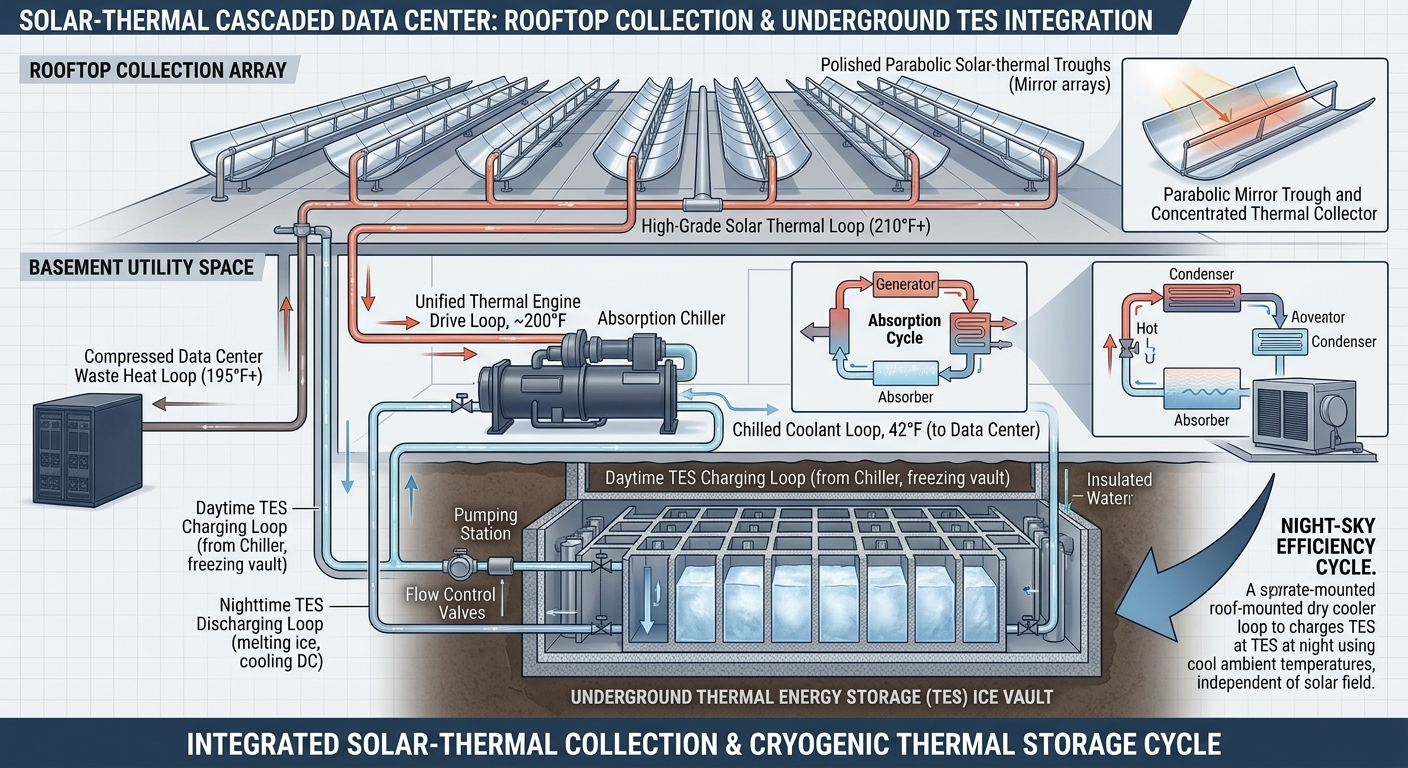
Liquid cooling loops leave the server rack at approximately 110°F to 135°F (43°C to 57°C). While this heat is plentiful, it is too diffuse to drive a classic thermal engine on its own. The system routes this warm return loop through a specialized industrial heat pump compressor filled with a modern, low-boiling-point refrigerant. By mechanically compressing the vaporized refrigerant, the molecules are forced together, stepping up the thermal gradient. This concentrates and multiplies the temperature, raising the fluid loop from a gentle 120°F up to a potent 195°F to 210°F (90°C to 99°C).
3.2 Solar-Thermal Interconnection
In sun-drenched regions like Arizona or Nevada, daytime cooling demands skyrocket. To offset this, the facility integrates rooftop parabolic solar-thermal trough collectors. Unlike photovoltaic panels that generate electricity, these mirrors directly capture and focus the sun's radiant heat onto a central conduit pipe, superheating an isolated fluid loop. This high-grade solar heat is merged with the compressed, stepped-up waste heat from the data center servers, creating a highly concentrated thermal stream without relying on fossil-fuel boilers.
3.3 Driving the Absorption Chiller
This hot, consolidated fluid loop is fed directly into an industrial absorption chiller (similar in principle to the thermal expansion cycle demonstrated in The Crazy Channel's Solar Refrigerator Project, but engineered on a mass-scale with a water-lithium bromide mixture). The 200°F+ thermal stream acts as the 'heat engine' for the chiller, boiling the refrigerant inside the unit to create a rapid pressure drop. This phase change drives a separate chilled water loop down to a crisp 42°F (5.5°C). This ice-cold water is piped right back into the server racks, achieving a closed refrigeration cycle driven predominantly by its own waste energy and daylight solar gain.
4. Thermal Storage and the Underground Ice Vault
A primary obstacle of solar-thermal cooling is the day-night cycle. To guarantee constant, uninterrupted operation, this architecture incorporates an underground Thermal Energy Storage (TES) system.
During nighttime hours, the ambient desert temperature plummets, allowing the heat pumps and dry fluid coolers to operate at maximum thermodynamic efficiency. The system uses this night-sky efficiency and cheap off-peak electricity to 'charge' a massive, insulated underground vault filled with water or phase-change materials, turning it completely into a block of ice. During the blisteringly hot daytime hours, when solar heat is ramping up but peak electrical grid strain occurs, the facility discharges the vault. Warm server water loops are routed through the melting subterranean ice bunker, completely cooling the facility for hours with minimal compressor interaction. This shields the facility from the extreme midday atmosphere.
5. Structural Architecture Comparison Matrix
| Design Element | Legacy Data Center | Unified Fluid Ecosystem (This Architecture) | Primary Engineering Benefit |
|---|---|---|---|
| Server Air Delivery | Individual server fans; loud, open-air chassis pulling room air. | Fanless sealed cartridge blades; blind-mate fluid manifolds. | Zero acoustic noise; absolute elimination of dust-based component failures. |
| Thermodynamic Drive | Electrical grid-driven mechanical compressors and evaporative water loss. | Low-grade waste heat pump compression paired with solar troughs. | Drastic reduction in active facility power bills; zero municipal water consumption. |
| Climate Resiliency | Highly vulnerable to summer heatwaves and regional drought restrictions. | Underground ice storage vaults buffering daytime peak ambient loads. | Continuous 24/7 cooling stability in harsh, arid desert conditions. |
6. Real-World Decarbonization and District Heating Integration
While converting low-grade exhaust into electricity requires technical amplification, the most efficient immediate use of data center thermal energy is direct regional district heating. By feeding warm server fluid directly into municipal water networks, cities are replacing fossil-fuel boilers with compute-generated thermal energy, as outlined by the Environmental and Energy Study Institute (EESI).
6.1 The Nordic Model (Espoo & Hamina, Finland)
Finland features some of the world's most advanced data-center-to-city integrations due to its pre-existing underground district heating networks.
- The Project: Microsoft Corporation partnered with Finnish utility provider Fortum Oyj to build a massive heat-recovery facility at a new data center cluster in Kirkkonummi, a model detailed in Bloomberg's District Heating Feature.
- The Impact: The system uses industrial water-to-water heat pumps to upgrade server exhaust to 60–90°C (140–194°F). This upgraded thermal stream is then piped directly into the district heating network, supplying clean heat to 250,000 homes and businesses in Espoo, effectively covering 40% of the city's winter heating needs. Concurrently, Google has routed its Hamina facility to supply 80% of the annual heat demand for its local district, verified by the International District Energy Association (IDEA).
6.2 The Tallaght District Heating Scheme (Dublin, Ireland)
- The Project: In Ireland, the local government established its first not-for-profit energy utility, Heat Works.
- The Impact: This public utility captures 100% of the low-grade waste heat coming off a nearby Amazon Web Services (AWS) data center. Spurred by strict European Union regulations requiring all data centers over 1 Megawatt to capture waste heat, this setup routes the thermal loop to supply 92% of the heating demand for a nearby university campus and local civic buildings, saving thousands of tons of carbon annually, as documented by CNBC Sustainability.
7. Financial Viability and Cost-Benefit Analysis
To evaluate the financial viability of this architecture, it must be analyzed as a capital-expenditure (CapEx) investment weighed against long-term operating-expense (OpEx) savings. The analysis below models a standard 100-megawatt (MW) hyperscale data center situated in an arid, high-tariff zone of the American Southwest, such as Arizona or Nevada. All figures are planning-level estimates intended for comparison, not engineering quotes.
7.1 Resource and Energy Savings Profile
Switching from a traditional evaporative, air-chilled data center to this unified fluid ecosystem achieves substantial resource reductions:
- Water Savings (~98% to 100% Reduction): Large hyperscale centers generally consume one to five million gallons of water per day, according to Nature Forward, and the largest sites can use up to 5 million gallons daily, or about 1.8 billion gallons per year, per EESI's water-consumption analysis. This model assumes a legacy 100MW evaporative facility consumes 1 million to 3 million gallons per day during peak summer loads. Because this architecture uses a completely sealed fluid loop and an underground ice vault, direct water consumption drops to near zero, saving roughly 365 million to 1.1 billion gallons of water annually.
- Energy Savings (~40% to 50% Reduction in Cooling Energy): Cooling systems can account for 38% to 40% of a data center's electricity consumption, according to the Congressional Research Service (CRS). By eliminating high-RPM chassis fans and using solar-thermal collectors to power the absorption chiller during daylight hours, the cooling power bill drops by roughly $12 million to $18 million annually. This assumes an industrial electricity rate of $0.07 per kWh, consistent with Arizona's year-to-date 2026 average industrial price of 7.34¢/kWh reported by the U.S. Energy Information Administration and compiled by DataCenterScope.
7.2 Capital Expenditure (CapEx) Estimation
JLL's 2026 Global Data Center Outlook places average shell-and-core construction at about $11.3 million per MW, as summarized by LMCIC, or roughly $1.13 billion for a 100MW facility. The specialized systems below add an estimated $51 million to $72 million, a premium of roughly 4.5% to 6.5% over that baseline. This sits below the 7% to 10% construction premium Turner & Townsend reports for U.S. liquid-cooled facilities, as compiled by Metro Colo Advisory, and should be validated against site-specific contractor bids. The incremental costs break down into four logical layers:
- Custom Sealed Fanless Racks & Blind-Mate Piping: $15,000,000 – $20,000,000. Premium for custom copper cold plates, dielectric fluid, hermetic HEPA cabinet sealing, and manifold systems in place of mass-produced sheet-metal server chassis.
- Rooftop Parabolic Solar-Thermal Array: $8,000,000 – $12,000,000. Mirrors, high-temperature tracking conduit loops, and integration plumbing.
- Industrial Absorption Chillers & Heat Pumps: $10,000,000 – $14,000,000. Water-lithium bromide absorption units and custom refrigerant-based thermal-amplifying compressors.
- Underground Thermal Energy Storage (TES) Ice Vault: $18,000,000 – $26,000,000. Subterranean excavation, advanced structural insulation, reinforced concrete vaulting, internal heat-exchanger grid piping, and dedicated pumping stations.
Total Incremental CapEx Premium: $51,000,000 to $72,000,000
7.3 Litigation, Public Pushback, and Permitting Savings
Data centers face intense, costly delays due to local public pushback over water rights and grid depletion. Data Center Watch found that $18 billion of U.S. data center projects were blocked and another $46 billion delayed over a two-year period in the face of opposition from residents and activist groups. The trend is accelerating: 45 projects worth approximately $68 billion were blocked or delayed between April and June 2026 alone, as reported by Bloomberg. In arid regions, this public friction carries a direct financial penalty:
- Direct Legal Fees & PR Campaigns: Combating environmental lawsuits, local water board appeals, and environmental impact report (EIR) adjustments is estimated to cost major operators $2,000,000 to $5,000,000 in direct legal retainers and lobbying.
- The Cost of Delay (Opportunity Cost): A 100MW data center delayed by 2 to 3 years due to zoning fights over local water depletion traps hundreds of millions of dollars in idle capital. At modern computing lease rates, this model conservatively treats every year of delay as $10,000,000 to $30,000,000 in deferred or lost revenue.
- The Eco-Premium Fast-Track: Because this system uses zero municipal water, it bypasses the water-related regulatory choke points that drive much of this opposition, which this model estimates shortens the municipal permitting cycle by 12 to 24 months.
Total Litigation & Delay Cost Savings: $12,000,000 to $35,000,000
7.4 Government Incentives for Green Data Centers
Government incentives can offset part of the infrastructure premium, but the policy landscape shifted sharply in 2025 and 2026, so this model counts only incentives still available to a project beginning construction today. Under the One Big Beautiful Bill Act, solar and wind facilities that begin construction after July 4, 2026, must be placed in service by December 31, 2027, to claim the federal clean electricity investment credit (Section 48E), but that phase-out does not apply to energy storage technology, as summarized by Stoel Rives. For projects of 1 MW or greater, the base credit is 6%, rising to 30% when prevailing wage and registered apprenticeship requirements are met, per IRS Publication 6045.
- Federal Energy Storage ITC on the Ice Vault (Section 48E): Treasury's Section 48E rules define thermal energy storage property as a system directly connected to an HVAC system that removes heat from, or adds heat to, a storage medium for later use in heating or cooling a commercial building, and exclude a building or its structural components, per the Federal Register. The vault's storage medium, heat-exchanger grid, and pumping stations fit this definition, while the excavation and concrete vaulting may be treated as structural and excluded. This model therefore assumes 50% to 75% of the vault cost is eligible basis at the 30% rate, yielding a credit of roughly $3,900,000 to $4,050,000. Domestic-content bonuses and foreign-entity restrictions could move this figure in either direction.
- Solar-Thermal Array and Absorption Chillers (Not Counted): Section 48E covers electricity-generating facilities with zero net emissions, plus certain energy storage, so a solar-thermal array that produces heat rather than power does not qualify. The legacy Section 48 credit, which covered solar and waste energy recovery equipment, now requires construction to have begun before January 1, 2025, as noted by Eide Bailly. Treasury guidance also states that the HVAC system itself is not eligible thermal energy storage property, according to the Federal Register, which excludes the absorption chillers. This model assigns no federal credit to these layers.
- Arizona Computer Data Center Program (Currently Paused): Arizona's program provides state, county, and local Transaction Privilege Tax and Use Tax exemptions on qualifying data center equipment purchases, per the Arizona Commerce Authority. However, Arizona's 2026 budget (HB 4168/SB 1861) imposes a three-year moratorium that bars the Commerce Authority from accepting applications from July 1, 2026, until June 30, 2029, as reported by MultiState. An Arizona project starting today would receive no state sales tax benefit on its initial build, so this model counts $0 for Arizona.
- Nevada Data Center Abatements: Nevada's Governor's Office of Economic Development (GOED) offers data centers a sales and use tax abatement for up to 10 or 20 years on qualified capital equipment, reducing the rate to as low as 2% with GOED Board approval, plus a personal property tax abatement of up to 75%. The 10-year tier requires 10 Nevada-resident employees, wages of at least 100% of the statewide average, and $25 million in capital investment within five years; the 20-year tier requires 50 employees and $100 million, per GOED. Against Clark County's 8.375% combined sales tax rate, reported by Avalara, a reduction to 2% saves about 6.4% on the roughly $33,000,000 of racks, chillers, and solar equipment in the optimistic case, or about $2,100,000. The personal property tax abatement adds annual savings not quantified here.
Total Government Incentive Value: $3,900,000 (Arizona, federal credit only) to $6,150,000 (Nevada, federal credit plus state abatement)
7.5 Financial Return on Investment (ROI) Matrix
To map out the payback period, the operational resource savings are combined with the avoided litigation and timeline penalties and the government incentives identified in Section 7.4. Adjusted net cost equals the CapEx premium minus one-time avoided penalties and incentives; the payback period divides that net cost by annual OpEx savings.
| Financial Element | Conservative Estimate | Optimistic Estimate |
|---|---|---|
| Initial Extra Capital Cost (CapEx) | +$72,000,000 | +$51,000,000 |
| Annual Power & Water Savings (OpEx) | -$13,000,000 / year | -$19,000,000 / year |
| Avoided Litigation & Delay Penalties | -$12,000,000 (one-time) | -$35,000,000 (one-time) |
| Government Incentives (Tax Credits & Abatements) | -$3,900,000 (one-time) | -$6,150,000 (one-time) |
| Adjusted Net Cost After One-Time Savings | $56,100,000 | $9,850,000 |
| Final Payback Period (Break-Even) | ~4.3 years | ~0.5 years (about 6 months) |
7.6 Summary of the Investment Return
If a tech firm encounters heavily organized public pushback and environmental gridlock, the fast-tracked permitting of this zero-water facility can recover the infrastructure premium in about six months in the optimistic case and in roughly 4.3 years in the conservative case. If the facility is built in a region with minimal legal friction, payback relies on resource savings and government incentives alone and extends to roughly 2.4 to 5.2 years. Incentive value depends heavily on jurisdiction and timing, so siting in a state with active data center abatements, such as Nevada, materially improves returns compared with Arizona during its current moratorium. In either scenario, the savings then convert entirely into operational gains for the remainder of the facility's 20-year design life.
7.7 Incentives for Rack Manufacturers
The facility-level incentives in Section 7.4 accrue to the data center owner. A manufacturer that tools up to mass-produce sealed fanless cartridges, cold plates, and blind-mate manifolds faces a separate and considerably thinner incentive landscape. None of the programs below is counted in the ROI matrix in Section 7.5.
- Section 48C Advanced Energy Project Credit (Closed): Section 48C offered a 30% investment credit for building or re-equipping clean energy manufacturing facilities, but its $10 billion pool was fully allocated in two rounds, in March 2024 and January 2025, and the One Big Beautiful Bill Act bars reallocating rescinded credits, according to Cenet Capital. Absent new appropriations from Congress, the credit is not available to a new rack production line.
- Section 45X Advanced Manufacturing Production Credit (Not Applicable): Section 45X rewards U.S. production of solar components, battery components, inverters, and critical minerals, per Crux. Racks, cold plates, and fluid manifolds are not eligible components.
- Federal R&D Funding (ARPA-E COOLERCHIPS): ARPA-E's COOLERCHIPS program targets reducing total cooling energy to less than 5% of a typical data center's IT load and has committed $42 million across 15 projects, per ARPA-E. This class of funding supports prototyping and validation rather than mass production, and future funding rounds are not guaranteed.
- State Manufacturing Incentives: State programs are the most realistic source of production-scale support. Arizona's Qualified Facility Tax Program provides refundable income tax credits for capital investment and job creation to businesses that build or expand qualified facilities, as summarized by Stream Data Centers; eligibility for a rack production plant should be confirmed with the Arizona Commerce Authority. Nevada's standard GOED abatements cover sales and use tax on capital equipment purchases, personal property tax, and modified business tax, per GOED's Tax Abatements Overview.
- First-Mover Advantage: No federal program rewards being first to mass-produce a technology. A first mover's advantage instead comes from patent protection, early supply agreements with hyperscale operators, and negotiated state incentive packages. Because liquid-cooled racks with blind-mate quick-disconnect manifolds are already commercially available, the defensible novelty is likely the fully sealed, fanless cartridge integrated with the facility-level thermal cascade rather than liquid-cooled racks in general.
8. Works Cited
**[Brookings_Institution_2024]** Brookings Institution. (2024). AI, data centers, and water: Assessing the regional hydrological strains of next-generation computing infrastructure. *Brookings Research Repository.*
**[Bloomberg_2025]** Bloomberg Features. (2025). Finland’s Data Centers Are Heating Cities, Too: Pairing power-hungry infrastructure with district heating networks. *Bloomberg Green.*
**[EESI_2023]** Environmental and Energy Study Institute (EESI). (2023). Thermal Energy Networks: Turning data center waste heat into a localized hot commodity. *EESI Briefings.*
**[EESI_2026]** Environmental and Energy Study Institute (EESI). (2026). Thermal Energy Networks Turn Data Center Waste Heat into a Hot Commodity. *EESI Energy Frontiers.*
**[IDEA_2026]** International District Energy Association (IDEA). (2026). European Data Centers Reuse Waste Heat to Heat Homes. *District Energy Journal.*
**[Microsoft_2022]** Microsoft Cloud Infrastructure Team. (2022). Azure Heat Reuse Paradigms: Scaled municipal district heating integrations in northern European clusters. *Microsoft Corporate Sustainability Reports.*
**[Rice_University_2025]** Rice University Department of Mechanical Engineering. (2025). Thermodynamic upcycling of low-grade data center exhaust using coupled Organic Rankine Cycles and solar-thermal concentration. *Rice Innovation Insights.*
**[The_Crazy_Channel_2024]** The Crazy Channel. (2024). This Refrigerator Turns the SUN HEAT into ICE -48°C: Implementing small-scale absorption refrigeration cycles via concentrated thermal energy. *YouTube Technical Archive.*
**[CNBC_2026]** Turner, J. (2026). This university campus is heated by an AI data center: The Tallaght District Energy Scheme. *CNBC Tech & Sustainability.*
**[CRS_2025]** Congressional Research Service. (2025). Data Centers and Their Energy Consumption: Frequently Asked Questions (R48646). *Congressional Research Service Reports.*
**[Data_Center_Watch_2025]** Data Center Watch. (2025). $64 billion of data center projects have been blocked or delayed amid local opposition. *Data Center Watch Reports.*
**[Bloomberg_2026]** Bloomberg News. (2026). Pushback Stalls $68 Billion in US Data Center Projects. *Yahoo Finance.*
**[DataCenterScope_2026]** DataCenterScope. (2026). Data Center Electricity Cost by State in 2026: Compiling U.S. EIA Electric Power Monthly, Table 5.6.B. *DataCenterScope Power Research.*
**[EESI_2025]** Yañez-Barnuevo, M. (2025). Data Centers and Water Consumption. *Environmental and Energy Study Institute (EESI) Articles.*
**[LMCIC_2026]** LMCIC. (2026). Data Center Construction Costs in 2026: An Owner's Guide. *LMCIC Insights.*
**[Metro_Colo_Advisory_2026]** Metro Colo Advisory. (2026). Data Center Cost 2026: Build, Lease and Run Costs Per MW. *Metro Colo Advisory Research.*
**[Nature_Forward_nd]** Nature Forward. (n.d.). Data Centers and Water Use: How Water Consumption Impacts the Environment and Local Communities. *Nature Forward.*
**[Arizona_Commerce_Authority_nd]** Arizona Commerce Authority. (n.d.). Computer Data Center Program. *Arizona Commerce Authority Incentives.*
**[Avalara_2026]** Avalara. (2026). 2026 Clark County Sales Tax Rate. *Avalara Tax Rates.*
**[Eide_Bailly_2025]** Eide Bailly. (2025). What the One Big Beautiful Bill Act Means for Section 48 & 48E Energy Credits. *Eide Bailly Insights.*
**[Federal_Register_2024]** U.S. Department of the Treasury & Internal Revenue Service. (2024). Definition of Energy Property and Rules Applicable to the Energy Credit. *Federal Register.*
**[Federal_Register_2025]** U.S. Department of the Treasury & Internal Revenue Service. (2025). Section 45Y Clean Electricity Production Credit and Section 48E Clean Electricity Investment Credit. *Federal Register.*
**[GOED_2026]** Nevada Governor's Office of Economic Development (GOED). (2026). Business Incentives: Data Center Abatements. *GOED Programs & Incentives.*
**[IRS_2025]** Internal Revenue Service. (2025). Tax-Exempt Entities and the Investment Tax Credit (§ 48 and § 48E) (Publication 6045). *IRS Publications.*
**[MultiState_2026]** MultiState. (2026). State Data Center Policy Shifts as Governors Impose New Restrictions. *MultiState Insider.*
**[Stoel_Rives_2025]** Stoel Rives LLP. (2025). The One Big Beautiful Bill Modifies Renewable Energy Tax Credits. *Stoel Rives Insights.*
**[ARPA-E_2024]** Advanced Research Projects Agency–Energy (ARPA-E). (2024). COOLERCHIPS 2024 Annual Meeting. *ARPA-E Events.*
**[Cenet_Capital_2026]** Cenet Capital. (2026). 48C Qualifying Advanced Energy Project Credit: How the Allocation Program Works. *Cenet Capital Blog.*
**[Crux_2026]** Crux. (2026). §45X tax credit: A 2026 guide for manufacturers. *Crux Blog.*
**[GOED_2024]** Nevada Governor's Office of Economic Development (GOED). (2024). Tax Abatements Overview. *GOED Publications.*
**[Stream_Data_Centers_2025]** Stream Data Centers. (2025). Overview of Arizona State Data Center Tax Incentives. *Stream Data Centers Resource Library.*